FRAME YOUR SUCCESS TODAY
From diplomas to professional credentials, find expertly crafted frames designed to preserve what you earned.
How to Update, Display, and Preserve Your Diploma After a Legal Name Change

Your diploma represents a specific moment in your life: the day years of work became an academic achievement you could hold in your hands. But life continues after graduation, and the name printed on that document may not always remain the name you use.
You may have changed your surname after marriage, returned to a previous name after divorce, updated your name during a gender transition, taken a family name through adoption, or completed a legal name change for another personal reason.
Whatever the circumstances, one question often follows: What should you do with a diploma that displays your former name?
You are not automatically required to replace it. You may continue displaying the original, request a replacement, preserve both versions, or store the diploma until you feel ready to decide. The right option depends on your university's policy, your professional needs, and your relationship with the name printed on the document.
Does a Legal Name Change Affect Your Diploma?
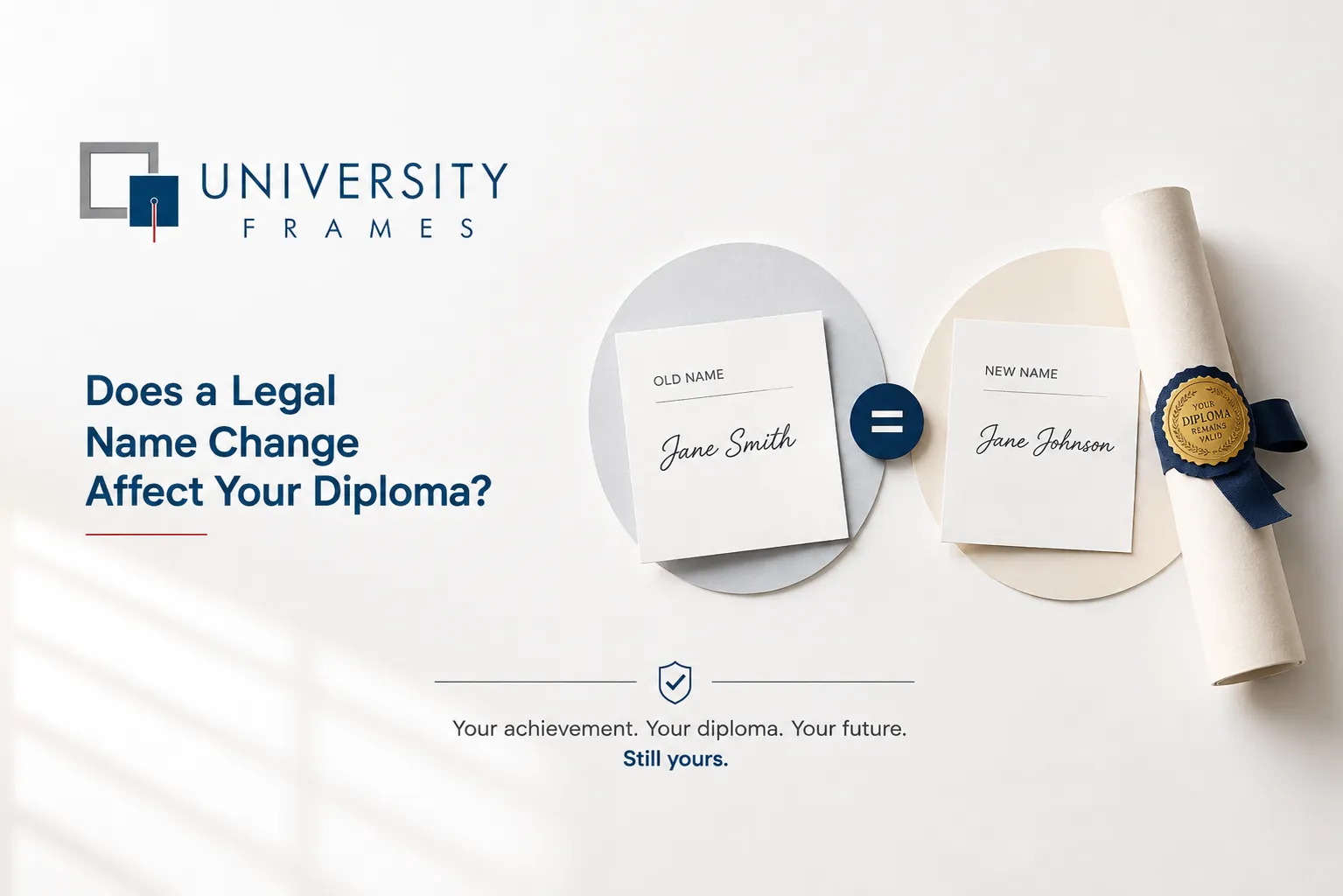
A legal name change does not erase or invalidate the degree you earned. The original diploma remains an authentic record of the academic achievement awarded to you at the time of graduation.
In most professional situations, employers do not verify education by examining the diploma hanging on a wall. Degrees are generally confirmed through official transcripts, registrar records, or education-verification services. The National Student Clearinghouse, for example, works with institutions and employers to verify academic credentials.
A difference between the name on your diploma and the name you currently use may require supporting documentation during a background check or licensing process. A marriage certificate, divorce decree, court order, or other legal record can usually establish the connection between the two names.
Replacing the physical diploma may still be worthwhile when:
- You want the credential displayed in your home or office to reflect your current name.
- Your former name causes discomfort or no longer represents your identity.
- You work in a client-facing or highly visible professional setting.
- A licensing organization expects consistency across credentials.
- You want your academic display to feel connected to your present life.
The decision may be administrative, emotional, or a combination of both.
Can You Change the Name on a College Diploma?
Many colleges and universities allow graduates to request a replacement diploma after a legal name change. However, there is no universal policy, and each institution determines its own documentation, fees, and replacement process.
For example, UCLA,High Point University, and Brown University each provide processes for obtaining replacement diplomas, but their requirements differ.
Your university's Registrar's Office should therefore be your first point of contact. Search the institution's official website for phrases such as "replacement diploma," "reissued diploma," "diploma name change," or "alumni record update." When the policy is unclear, contact the registrar directly.
Before submitting a request, confirm:
- Whether the university reissues diplomas after legal name changes
- Whether your student or alumni record must be updated first
- Which legal documents are accepted
- Whether the original diploma must be returned
- Whether the replacement will be marked as a duplicate or reissue
- Whether the graduation date will remain unchanged
- Which university officials will sign the new document
- Whether the diploma's design or dimensions have changed
- How much the replacement costs and how long it may take
These details can influence whether replacing the diploma feels worthwhile, especially when the original has sentimental or historical value.
What Documentation Might Be Required?
The registrar may ask you to complete a replacement-diploma form and provide government-issued identification along with evidence of your legal name change.
Depending on the reason for the change, acceptable evidence may include a marriage certificate, divorce decree, court order, updated passport, or driver's license. You may also need to provide your student identification number, degree information, graduation year, and payment for processing and shipping.
Some universities require graduates to return the original diploma before another is issued. Others allow both documents to remain with the graduate.
Because legal documents contain sensitive personal information, submit them only through an official university portal, verified mailing address, or another method authorized by the registrar.
Will the Replacement Look Like the Original?
A replacement diploma usually preserves the degree title and original graduation date, but it may not be visually identical to the document issued when you graduated.
Universities may use their current diploma design, typography, branding, seal, or paper stock. The replacement may also be signed by current administrators rather than the officials who held office during your graduation year. Some institutions add a reissue date or a small notation indicating that the diploma is a replacement.
For many graduates, these differences are minor. For others, the original signatures and design are an important part of the document's history.
Before surrendering your diploma, consider whether you would be comfortable receiving a document that represents the same academic achievement but looks different from the original.
Should You Replace the Diploma or Keep It?

There is no universally correct choice.
A replacement may feel right when your current name is central to your identity, when you have built your professional life under that name, or when seeing your former name creates discomfort. It may also make sense if the diploma will be displayed prominently in an office, classroom, clinic, or client-facing workspace.
Keeping the original may feel right when you view it as a historical record. The name on the document reflects who you were when you earned the degree, and that chapter may still hold meaning even if your name has changed.
You may also prefer the original because of its signatures, design, sentimental value, or connection to commencement day. When a university requires the original to be surrendered, these considerations become especially important.
If your institution allows you to retain the original, keeping both can offer a thoughtful balance. The original preserves the history of the achievement, while the replacement reflects the name you use today. You can display one and archive the other without treating either document as less meaningful.
Different Name Changes Can Carry Different Meanings
Although the university's administrative process may be similar in each situation, the personal meaning of replacing or keeping a diploma can vary. The decision should reflect how you relate to the name on the document, how you use the diploma professionally, and what feels right for your current life.
| Circumstance | What the Original Diploma May Represent | When a Replacement May Feel Appropriate |
| Marriage | The name you used when you completed your degree and began your professional journey. | When your current surname has become your established personal or professional identity, particularly if the diploma will be displayed in a home, office, classroom, clinic, or practice. |
| Divorce | A genuine record of the period in which the degree was earned, or a career was developed. | When removing a former married name is part of reclaiming your identity or creating a new chapter. |
| Gender transition | A document connected to an earlier identity that may no longer feel accurate or comfortable. | When an updated diploma would align the achievement with your current identity and reduce the need to encounter or disclose a former name. |
| Adoption or another legal name change | An earlier part of your personal, family, or cultural history. | When your current legal name better reflects your family, identity, cultural connection, personal safety, or present circumstances. |
There is no expectation that every graduate should make the same choice. Some people feel strongly connected to the original document, while others find that a replacement allows the diploma to feel fully connected to who they are today.
If you decide to request a replacement, contact the Registrar's Office and ask whether the institution offers a confidential process for former students. You should generally need to provide only the documentation required by the university's official policy—not a personal explanation for why your name changed.
Will Employers Care About the Name on Your Diploma?
In most cases, employers are more concerned with verifying the degree than with the name printed on the physical diploma.
Education may be confirmed through official transcripts, university records, verification services, licensing databases, or certified academic documents. When your current name differs from your academic record, you may simply need documentation connecting the two.
Updating the diploma itself does not automatically update your transcript, university database, professional license, certification, alumni record, or membership in a professional organization. Each institution or licensing body may have its own process.
If you work in a regulated profession, contact the relevant licensing board before assuming that replacing the diploma will resolve every record mismatch.
What If the Diploma Is Already Framed?
If your diploma is already framed, you may be able to reuse the existing frame, but open it carefully.
Place the frame face down on a clean, soft surface and remove the backing without bending it. Handle the diploma by its edges, avoid pressing on embossed seals or signatures, and never use household tape or glue when inserting or repositioning the document.
University Frames' guide to cleaning and maintaining a certificate frame provides additional advice for protecting both the frame and the document.
If the frame has a sealed backing, unfamiliar fasteners, adhesives, or a detailed custom mat, ask a professional framer to open it. Attempting to force the frame apart can damage the diploma, mat, or molding.
Will the Replacement Fit Your Existing Frame?
A replacement diploma is not always the same size as the original. Universities may update their diploma dimensions, margins, seals, or layout over time.
Wait until the replacement arrives before assuming that it will fit. Measure the document from edge to edge and compare it with the existing mat opening. University Frames' guide on how to measure your diploma explains the process.
Even when the paper size is unchanged, the position of the graduate's name, signatures, university seal, and decorative borders may differ. A mat that suited the original may cover important details on the replacement.
When the existing frame remains in good condition, a new mat may be enough. If the diploma dimensions or orientation have changed significantly, a new frame may provide a better result.
Ways to Display the Diploma After a Name Change
How you display the diploma can reflect both your current identity and the history behind the achievement.
Display the Replacement and Preserve the Original
Many graduates choose to frame the updated diploma and store the original flat in an archival folder or sleeve. This allows the visible credential to reflect the current name while preserving the original as a personal record.
Continue Displaying the Original
You may decide that the original diploma remains the version with the strongest connection to graduation. Displaying a diploma with a former name does not invalidate your present identity or diminish the achievement.
Preserve Both and Decide Later
You do not have to make a permanent decision immediately. Both documents can be stored safely while you consider which one you want to display in your current home or professional space.
Display Both as Part of Your Story
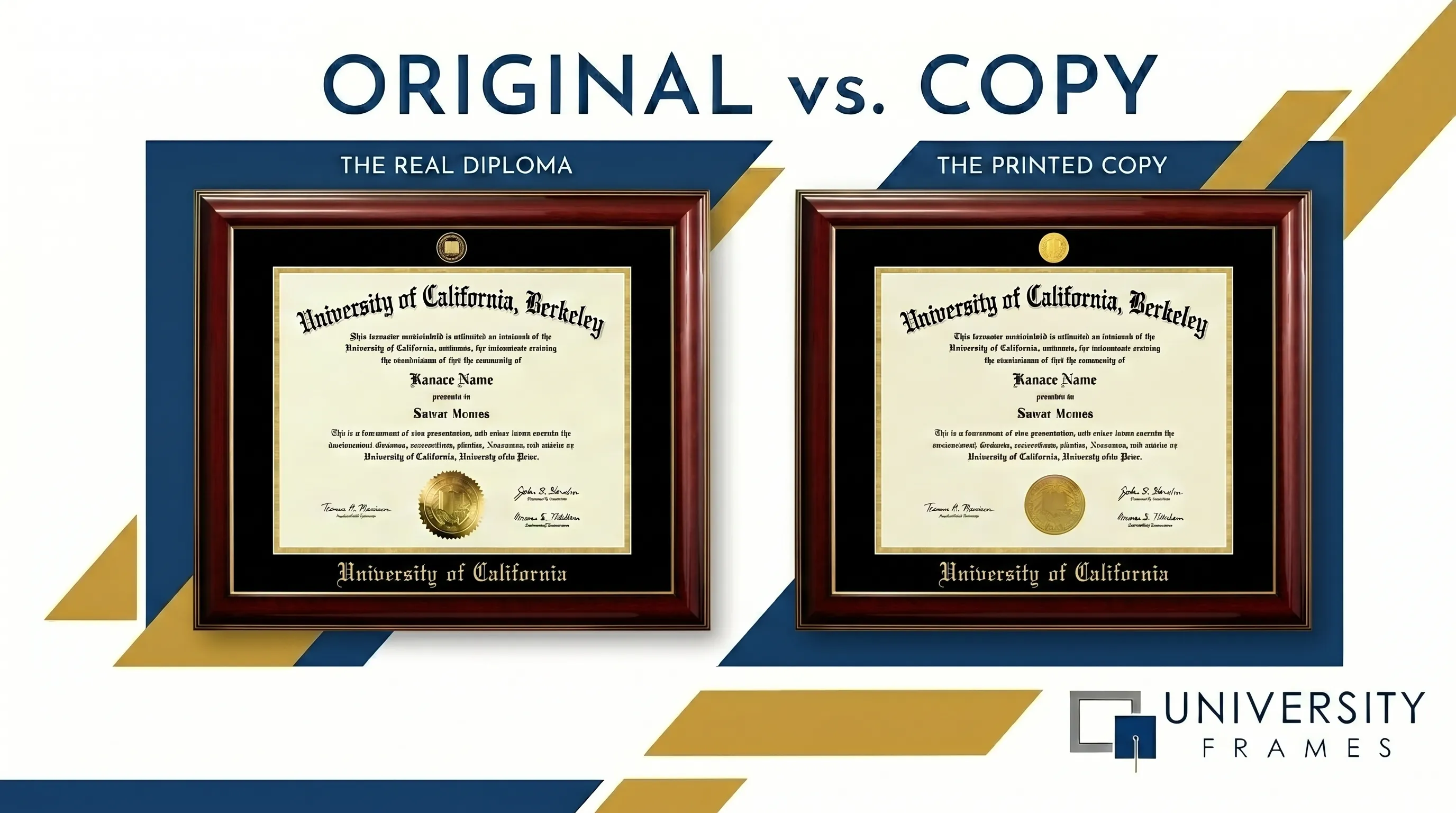
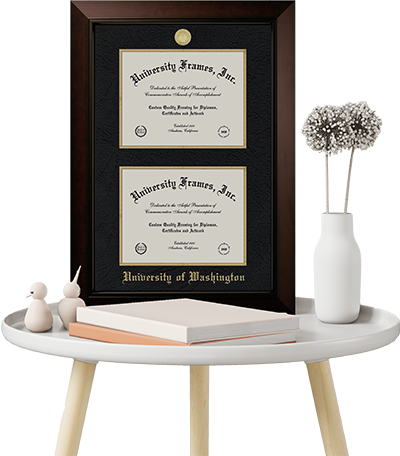
Some graduates may find meaning in displaying the original and replacement together. A custom two-opening layout can present them as connected chapters rather than competing documents.
University Frames double diploma frames are generally designed for multiple degrees or credentials, so confirm the dimensions and desired arrangement before selecting this option.
Refresh the Entire Presentation
A name change often happens alongside other life transitions, such as a new home, office, career, or professional role. A frame selected shortly after graduation may no longer suit your surroundings or personal style.
You may prefer a contemporary frame, traditional hardwood molding, neutral matting, school colors, an official seal, or a logo mat frame. Protective glazing may also be worth considering when the diploma will be displayed for many years.
How to Store the Diploma You Are Not Displaying
A diploma in storage remains vulnerable to light, moisture, adhesives, folds, and unstable temperatures.
The Library of Congress recommends keeping paper documents in supportive acid- and lignin-free enclosures, handling them with clean hands, and avoiding self-adhesive tapes and glues.
Store the diploma flat in an acid-free folder, archival box, or suitable polyester sleeve. Choose a cool, dry, stable room rather than an attic, basement, garage, or area near plumbing.
Do not laminate the diploma, fold it into a smaller container, or leave it rolled in a graduation tube for long-term storage. University Frames also explains how to store and protect a degree until it is framed.
Your Achievement Remains Yours
A name change marks a new chapter, but it does not rewrite the work that came before it.
Your original diploma may represent the person you were when you completed your education. A replacement may reflect the person you are today. Both can belong to the same story.
Whether you replace the diploma, continue displaying it, preserve both versions, or finally frame it for the first time, the achievement remains unchanged.
When you are ready to display it, University Frames can help you find a frame for your institution, confirm the correct measurements, and create a presentation that protects the document while honoring everything it represents.
A Quick Decision Checklist
Before requesting, displaying, or reframing a diploma:
- Review the university's official replacement policy.
- Confirm whether your student or alumni record must be updated first.
- Ask whether the original diploma must be returned.
- Verify the accepted legal-name-change documents.
- Confirm the replacement's design, dimensions, signatures, fee, and processing time.
- Update professional licenses and academic records separately where required.
- Decide whether to display the original, the replacement, or both.
- Measure the new diploma before ordering or altering a frame.
- Store every undisplayed document using archival-quality materials.
If the diploma has been lost or damaged rather than affected only by a name change, read The Complete Guide to Replacing a Lost or Damaged Diploma.
Frequently Asked Questions
Can I change the name on my diploma after marriage?
Many universities allow graduates to request a replacement after a documented legal name change. Contact the registrar to confirm the institution's requirements, fees, and record-update process.
Can I request a new diploma after divorce?
Possibly. The university may ask for a divorce decree, court order, updated identification, or another document confirming your restored legal name.
Does a diploma with my former name remain valid?
Yes. It still records the degree awarded to you. You may need supporting documentation to connect your former and current names during an official verification.
Do I have to replace the diploma?
Generally, no. Replacing the physical document is usually a personal choice unless a specific licensing or professional requirement applies.
Will the replacement have the original graduation date?
Many institutions preserve the original degree and graduation information, although they may also include current signatures, an updated design, or a reissue notation.
Will I have to return the original?
That depends on the institution. Confirm the policy before placing an order, especially when the original has sentimental value.
Can I reuse the existing frame?
Possibly. Measure the replacement after it arrives and check the position of its seal, signatures, text, and decorative borders before placing it behind the existing mat.
Can I keep and display both diplomas?
Yes, when the university allows you to retain the original. You may display both, rotate them, or frame the replacement and archive the original.

Latest Offers


The Quintessence of Achievement.
Your degree is a testament to your hard work and dreams. Frame it beautifully today and be reminded of your achievement every day.