FRAME YOUR SUCCESS TODAY
From diplomas to professional credentials, find expertly crafted frames designed to preserve what you earned.
Graduation Tassel Etiquette: Rules, Traditions, Colors, and Everything You Need to Know


Graduation regalia includes gowns, caps, hoods, cords, stoles, and medallions, but the tassel creates one of commencement's clearest visual moments. A class may enter the ceremony wearing tassels on one side and move them together after the degrees are officially conferred.
The familiar rule is simple: many high school, associate, and bachelor's candidates in the United States begin with the tassel on the right and move it to the left. Graduate-level customs are less uniform, and some institutions use different directions for every degree level.
This guide explains the common rules, the important exceptions, the meaning of tassel colors, mistakes to avoid, and practical ways to preserve the tassel after graduation.
Why the Graduation Tassel Matters
Academic dress developed from clothing worn at medieval European universities. In the United States, regalia became more standardized through the 1895 Intercollegiate Code. A concise overview is available in the University of Illinois Chicago's history of caps and gowns.
The tassel is small, but its position can signal academic status. The class-wide movement from right to left is commonly understood as the change from candidate to graduate. It also gives the ceremony a shared visual conclusion, even when the physical diploma is mailed later, or the graduate receives only a diploma cover on stage.
That symbolism explains why moving the tassel early can feel out of place: the gesture is intended to follow the official conferral, not replace it.
Which Side Does the Graduation Tassel Go On?

There is no single rule that applies to every school, country, or degree. The following conventions are common in the United States, but your commencement office, registrar, dean, or ceremony marshal has the final word.
High School, Associate, and Bachelor's Candidates
The most familiar convention is to wear the tassel on the right before the degree or diploma is awarded and move it to the left after the official cue. Current instructions from Monmouth University and Cal Poly Pomona use this right-to-left practice for bachelor's candidates.
For a current example, see Monmouth University's undergraduate commencement instructions, which direct undergraduates to begin with tassels on the right and move them when the president confers the degree. Cal Poly Pomona gives similar guidance and places master's and doctoral tassels on the left.
See also Cal Poly Pomona's commencement etiquette for a clear degree-level example.
Master's Candidates
Many universities instruct master's candidates to wear the tassel on the left from the beginning of the ceremony. At this level, the academic hood and the hooding process may be more significant than a tassel turn.
Central Connecticut State University, for example, tells undergraduate candidates to begin on the right while master's students begin on the left. See its current regalia information for the institution-specific distinction.
Doctoral and Professional Degree Candidates
Doctoral graduates often wear a tam rather than a mortarboard, and many institutions place the tassel on the left from the beginning. Other schools use a right-to-left turn for all degree levels. Professional programs in law, medicine, pharmacy, dentistry, and related fields may follow graduate-level rules or a ceremony designed specifically for that school.
Hooding is often the central ritual for advanced-degree graduates. Some candidates arrive wearing the hood, some carry it, and faculty members hood others on stage. Follow the instructions for the exact ceremony you are attending, especially when a university-wide commencement and a separate school or department ceremony use different procedures.
The Rule That Overrides Every General Guide
Read the official commencement email, website, rehearsal guide, or printed program. A school may direct all graduates to start on the left, ask master's candidates to turn their tassels, move the tassel after each graduate crosses the stage, or omit the tassel turn entirely. When the school's rule differs from a general tradition, follow the school.
When Should You Move the Graduation Tassel?
Wait for a clear signal. The cue usually comes after the president, chancellor, provost, dean, principal, or other presiding official formally confers the degrees. The speaker may say that candidates are now graduates and then ask the class to move the tassel.
At some ceremonies, the turn occurs as a single class-wide gesture near the end. At others, graduates are told to move the tassel after crossing the stage. Do not copy the person next to you unless the official cue is clear; neighboring graduates may be in a different degree group or may simply be moving early.
Move the tassel gently over the top of the cap. Pulling the cord sharply can shift the mortarboard, loosen the button, or send the cap off center just before photographs.
How to Wear the Cap and Tassel Correctly
Position the Mortarboard
Place the cap so the board sits flat and roughly parallel to the floor. One point should face forward toward the center of the forehead. A cap tilted far back may slide, while a cap pulled too low can interfere with your view and photographs.
Secure the Cap Before Ceremony Day
Try on the full regalia several days before commencement. Practice walking, sitting, standing, turning your head, shaking hands, and using stairs. Discreet hairpins, clips, combs, or a headband can help if your institution permits them.
Keep the Tassel Visible but Out of Your Face
Let the strands hang naturally rather than wrapping them around the cap button. Before portraits, check that the tassel is visible and not covering your eyes, glasses, or face.
Decorate the Cap Only When Permitted
Some schools welcome decorated mortarboards; others restrict height, wording, materials, or attachments. Check the ceremony rules before adding anything. For design ideas after confirming permission, read 4 Easy Steps to Decorate Your Grad Cap.
What Do Graduation Tassel Colors Mean?
A tassel color can identify a field of study, college, school, degree level, graduation year, or institutional tradition. The same color does not carry the same meaning at every institution, and some universities use one tassel color for all graduates.
Academic color systems are used most consistently on the velvet trim of graduate hoods, but many schools also apply discipline colors to tassels. The University of Pittsburgh's discipline-color guide and Notre Dame's tassel-color guide show how universities adapt these traditions.
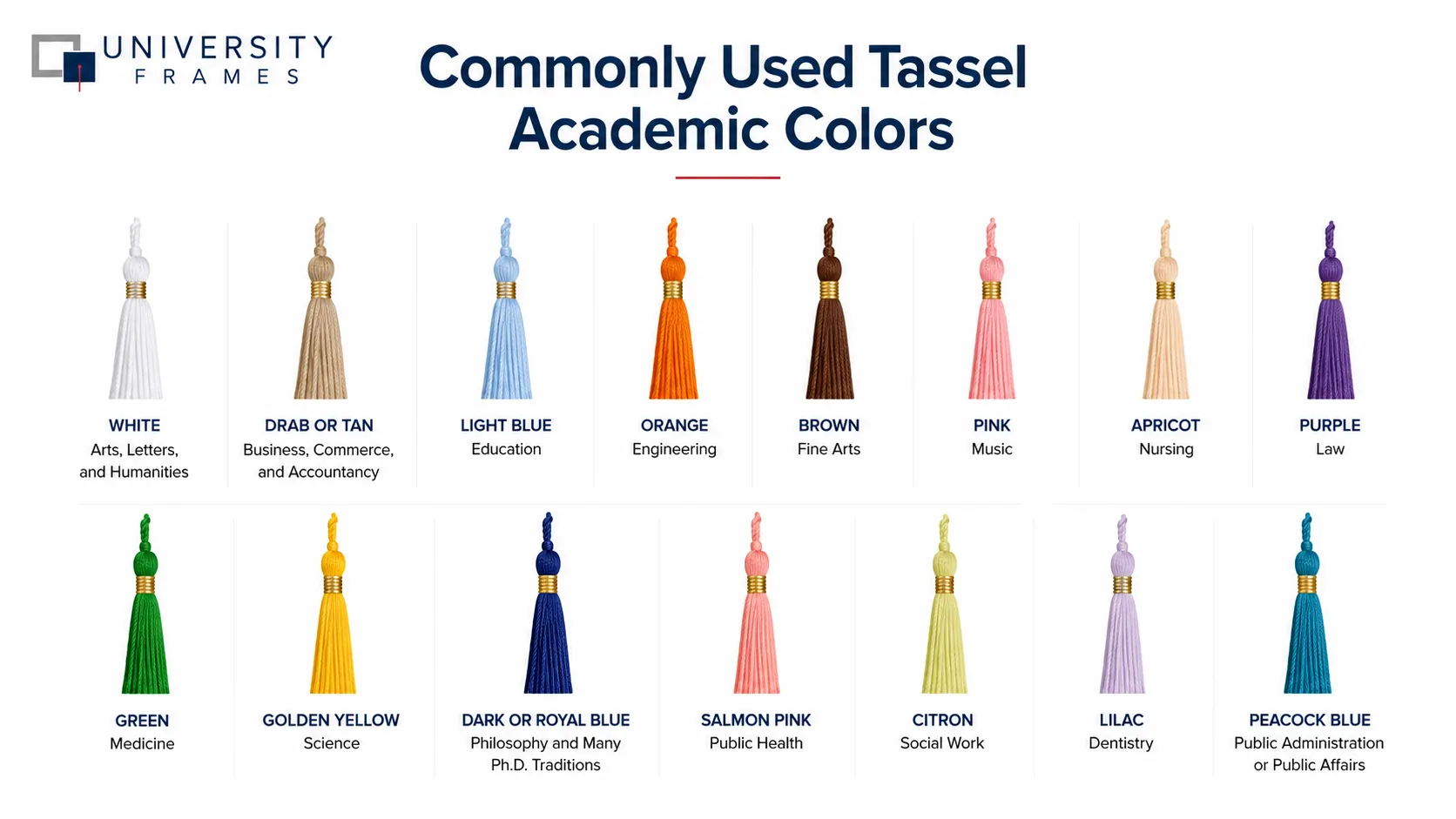
Commonly used academic colors include:
- White: arts, letters, and humanities
- Drab or tan: business, commerce, and accountancy
- Light blue: education
- Orange: engineering
- Brown: fine arts
- Pink: music
- Apricot: nursing
- Purple: law
- Green: medicine
- Golden yellow: science
- Dark or royal blue: philosophy and many Ph.D. traditions
- Salmon pink: public health
- Citron: social work
- Lilac: dentistry
- Peacock blue: public administration or public affairs
Treat this list as a general reference, not an ordering guide. Your school may use a custom palette, combine school colors, issue black tassels to all graduate students, or reserve gold for doctoral graduates, honors, or university officials.
Official, Honor, and Custom Tassels
Wear the Official Tassel During Commencement
Use the tassel issued or approved by the institution. If you are earning two degrees, completing a double major, or participating in more than one ceremony, ask whether one or two tassels are allowed and which color should be worn.
Do Not Assume Gold Always Means Honors
Gold may represent honors at one school, a doctoral degree at another, or simply an institutional color. Academic honors can also be shown through cords, stoles, medallions, pins, or special gown details. Wear only distinctions that were formally awarded and approved for the ceremony.
Save Custom Tassels for Photos When Necessary
A personalized tassel with a year charm, club emblem, or specialty design can be meaningful, but it may not be authorized for the formal ceremony. A practical approach is to wear the official tassel during commencement and use the custom version for portraits, announcements, parties, or keepsake displays.
Common Graduation Tassel Etiquette Mistakes To Avoid
- Moving the tassel too early. Wait until the degree is conferred or the ceremony leader gives the instruction.
- Assuming every degree follows the undergraduate rule. Master's, doctoral, and professional candidates often receive different directions.
- Wearing an unofficial color. Confirm the correct tassel with the bookstore, registrar, commencement office, or approved regalia supplier.
- Wearing the cap backward. The mortarboard should have a point centered toward the forehead.
- Adding unapproved cords, stoles, pins, or charms. Ceremony policies may limit accessories even when they are meaningful to the graduate.
- Trying on regalia for the first time at the venue. A quick practice session can prevent missing pieces, poor fit, and last-minute cap problems.
- Leaving before the ceremony ends. Commencement etiquette includes remaining through the recessional unless organizers instruct otherwise.
Tassel Etiquette for Graduation Photos
Take photographs before and after the ceremony. The first set records you as a degree candidate; the second records the completed milestone. For a clean portrait, check that the cap is level, the tassel is visible, the gown zipper is centered, and cords or stoles are not tangled. Graduates who want to display a portrait with their keepsakes can also explore graduation picture frames.
When holding the diploma or diploma cover, keep the tassel away from your face and avoid gripping the document by a corner, as it may bend. If the ceremony tassel is especially meaningful, include a close-up photograph of the charm and knot before placing it in storage or a frame.
What Should You Do With the Tassel After Graduation?
The tassel is one of the easiest pieces of regalia to keep, and it often becomes more meaningful with time. Before storing it, make sure the strands are dry, clean, and gently untangled. Do not trim the strands, staple the cord, or tape the tassel directly to the diploma.
Store It Without Crushing the Knot
Lay the tassel flat in an archival-quality box or allow it to hang without pressure on the knot. Keep it away from damp basements, hot attics, direct sunlight, pests, and adhesives. The National Archives' preservation guidance recommends cool, dry storage and suitable enclosures for important papers and photographs; the same do-no-harm approach is sensible for graduation keepsakes.
Display It Beside the Diploma
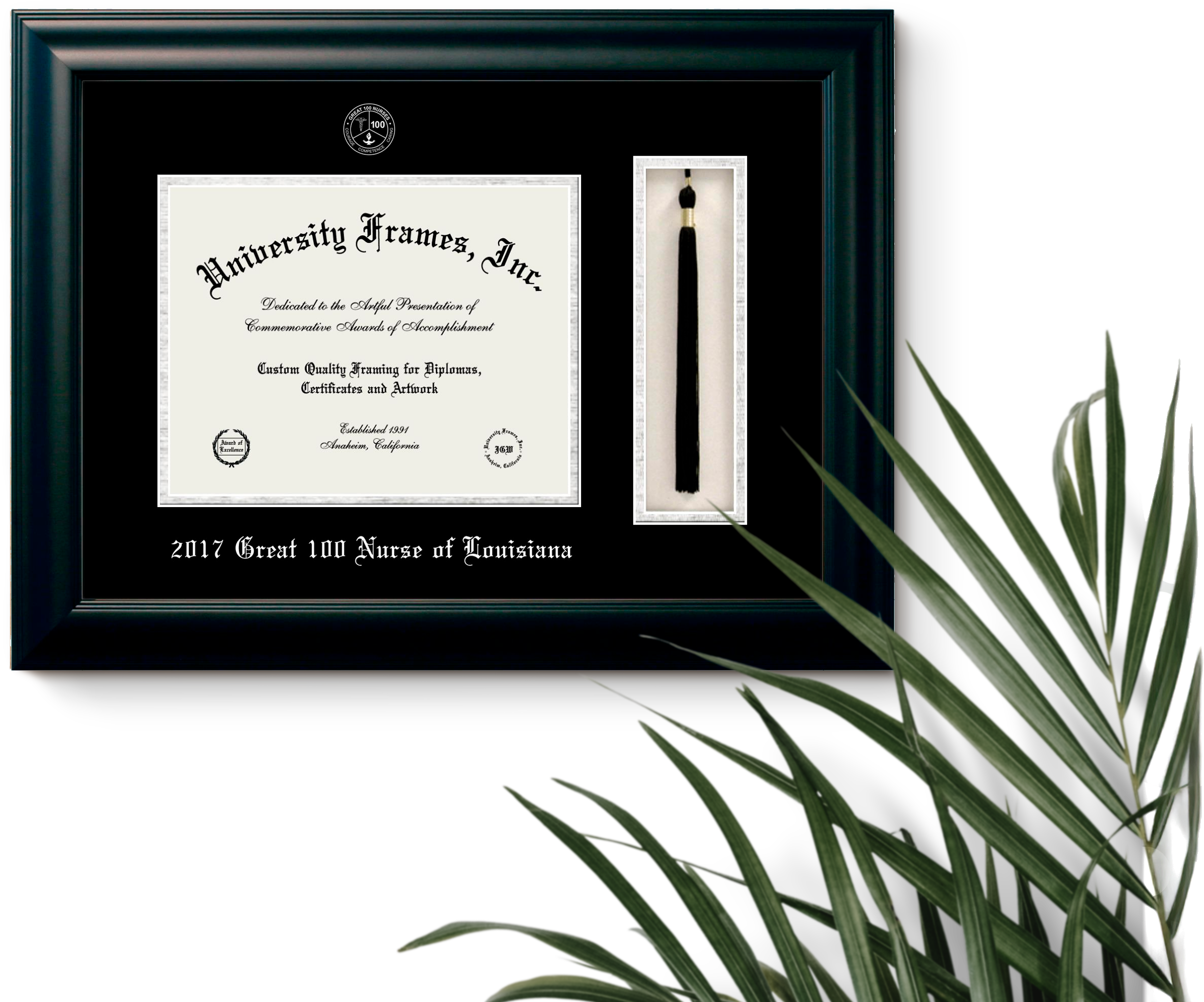
A dedicated diploma frame with tassel gives the tassel its own opening instead of pressing or taping it against the diploma. This creates a focused display: the diploma records the credential, and the tassel recalls the ceremony.
Before ordering, use University Frames diploma measurement guide to confirm the document's exact height and width. Diploma sizes vary by institution, degree, and issue year.
Choose Preservation-Minded Framing Materials
For the original diploma, look for acid-free or pH-neutral matting, appropriate backing, safe mounting, spacing between the paper and glazing, and protection from strong light. In contrast, the National Archives' guidance on displaying family papers explains why UV-filtering glazing, suitable mat board, and separation from the glass matter.
No glazing eliminates all light damage. Display the frame away from direct sun, bright windows, fireplaces, heating vents, bathrooms, and other areas with strong temperature or humidity changes. If the diploma itself is missing or damaged, University Frames also explains the replacement process in The Complete Guide to Replacing a Lost or Damaged Diploma.
Build a Coordinated Keepsake Display
A graduation display can include a portrait, campus image, announcement, honor cords, medal, or commencement program, but it does not need to hold everything at once. A crowded frame can distract from the diploma and place unnecessary pressure on delicate items.
For graduates planning another degree, a coordinated pair of frames or a double diploma frame may be cleaner than forcing multiple achievements into one small opening.
Final Answer: Follow the School, Then Preserve the Moment
For many U.S. high school, associate, and bachelor's candidates, the tassel begins on the right and moves to the left after the degree is conferred. Many master's and doctoral candidates wear it on the left throughout the ceremony. The most important rule is still the simplest: follow the directions issued for your specific commencement.
After graduation, keep the tassel dry, untangled, and away from permanent adhesives. Displayed beside the diploma, it preserves both parts of the achievement the official credential and the moment it became yours.
FAQs About Graduation Tassel Etiquette
Which side should a graduation tassel be on before the ceremony?
At many U.S. high school, associate, and bachelor's ceremonies, it begins on the right. Many master's and doctoral graduates begin on the left. Follow the instructions for your school and degree level.
When do you move the tassel from right to left?
Move it after the degree is formally conferred or when the ceremony leader gives the cue. Some schools use a class-wide turn; others instruct graduates to move it after crossing the stage.
Do master's students move their tassels?
Often they do not. Many institutions direct master's candidates to wear the tassel on the left throughout the ceremony, although some schools use a different custom.
Where does a doctoral tassel go?
Doctoral graduates commonly wear the tassel on the left or on a tam with a fixed tassel. Hooding is usually the central advanced-degree ritual.
What do graduation tassel colors mean?
A color may identify a field of study, college, school color, degree level, honors category, or graduation year. The institution's official color guide is the only reliable source for a specific ceremony.
Can you wear two graduation tassels?
Some schools allow two tassels for dual degrees, double majors, or special recognition; others allow only the official tassel assigned to the graduate. Ask the commencement office before wearing both.
Is a gold tassel always an honor tassel?
No. Gold can represent honors, a doctoral degree, an institutional color, or an official role, depending on the school.
Can a graduation tassel be framed?
Yes. A frame with a separate tassel opening can display it without taping or stapling it to the diploma.

Latest Offers


The Quintessence of Achievement.
Your degree is a testament to your hard work and dreams. Frame it beautifully today and be reminded of your achievement every day.